THANK YOU FOR SUBSCRIBING

Be first to read the latest tech news, Industry Leader's Insights, and CIO interviews of medium and large enterprises exclusively from Logistics Transportation Review

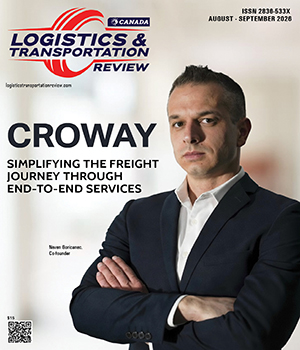
When Croway was launched in 2015 with a single truck and a vision rooted in hard work and growth in the transportation industry, only a few could have predicted the scale of its transformation. A decade later, that grass-root operation—built on grit, reliability, and service excellence—has evolved into one of Nova Scotia’s most trusted names in container drayage and logistics. As a full-service provider, Croway specializes in scalable freight solutions tailored to diverse maritime clients, particularly those in the fisheries and international trade industries. Its commitment to responsive, scalable service is clear in its wide-ranging offerings, from container drayage and port-to-door delivery to long-haul trucking and brokerage services across Canada and the U.S. The company also offers warehousing solutions where cargo can be safely stored, transferred or prepped for the next leg of its journey. Behind these offerings is a finely tuned logistics engine—30 trucks and over 100 pieces of equipment working in concert. This in-house capability allows the company to handle a wide variety of shipping needs. “Backed by a fleet built to adapt, we bring the scale, speed, and flexibility needed to handle everything from complex logistics chains to single-container moves,” says Karolina Goricanec, co-founder. At Croway, logistics isn’t just a service—it’s a promise delivered from start to finish. By taking the whole process off clients’ plates, the company eliminates stress and ensures every shipment is managed carefully by industry pros who know the stakes.
Every great innovation begins as a single drop in a still pond—an idea that ripples outward, creating waves of change. For Chris An, the founder of FleetNexus, the question, "What if there was a better way to manage fleets?" was that drop. It wasn’t just a momentary ripple but the start of a transformative current, reshaping fleet management through decades of vision, persistence, and innovation. An’s journey began in Beijing as a product director at Baidu, often referred to as “China’s Google,” where he gained invaluable experience in building scalable systems. This role honed his technical expertise and sparked his interest in solving large-scale operational challenges. In 2015, inspired by the growing demand for seamless travel solutions, An launched his first startup, backed by Eddie Wu, the CEO of Alibaba, with an investment of 12 million RMB. The company connected Chinese travelers with global chauffeur services. The venture proved successful and was later acquired by Trip.com. As CEO of Trip.com’s international ground transportation division, he gained insight into the inefficiencies of fleet management—a realization that ultimately led him to found FleetNexus. “When managing over 1,500 cities worldwide, deeper issues in the system became apparent—supply was disconnected, operations inefficient, and small operators struggled to grow. I knew there had to be a better way,” says An. Today, the company bridges the gap between local fleet operators and the global demand for transportation services. Through an intuitive dashboard, fleet managers can monitor activities, manage bookings, and dispatch vehicles with a click. The platform helps operators of all sizes—from small businesses with ten vehicles to enterprises with 500—streamline processes and cater to international demand. It also offers real-time tracking for drivers via an easy-to-use app available on iOS and Android. This app tracks driver activity, location, and customer interactions, ensuring safety and accountability.


John Rutherford, Owner and CEO, Bob Tamblyn, President, May Marlow, Director of Customs Compliance
When a major American automotive manufacturer found its supply chain paralyzed and trucks idling at the border, it wasn’t one of the global logistics conglomerates that came to the rescue. Instead, the call went to a mid-sized Canadian firm: Jack Rutherford Customs Brokers Limited (part of The Rutherford Group). The company had trucks moving again within two hours on a Friday afternoon. By Monday, the automaker had entrusted them with its entire Canadian business. This is how the firm operates. Not by scale alone, but by agility and a fierce commitment to client service. In a $10-billion Canadian customs brokerage industry dominated by faceless giants, that approach is quietly winning it business. From Brokerage to Full-Service Partner International trade has always been about scale. The largest brokers handle thousands of daily transactions, built on industrial efficiency and digital portals. In the process, clients, especially smaller importers, often find themselves lost in bureaucratic red tape, unable to reach a human voice when shipments stall. Rutherford sees its opening there. “Clients come to us because they want service. They want a person to talk to,” says Bob Tamblyn, President. That deceptively simple value proposition—accessibility—has become a differentiator in a sector known more for opacity than transparency. Founded more than half a century ago, Rutherford built its name serving small and medium importers, defined by Canadian regulators as those with fewer than 2,500 entries a year. Over time, it has attracted multinationals, too, often dissatisfied with the rigid systems of their larger brokers. What began as a brokerage has evolved into something closer to a full-service trade solutions group. Under the Rutherford Group banner, the company now operates bonded and FDA-approved warehouses in Michigan, a network of domestic and cross-border trucks, and a growing freight forwarding arm spanning China, Europe, and Australia. The goal is to offer importers and exporters one point of contact across the complexity of global trade. “Clients don’t have to change their business to accommodate us,” notes May Marlow, Director of Customs Compliance. “We change to accommodate them.” Rutherford builds the account around the client, not the other way around. Some want to review entry documents before submission; others need billing split across multiple entities, or invoicing in different currencies depending on destination. The team will configure workflows, approvals, and billing so the importer’s operations don’t have to conform to a broker’s template. That flexibility extends to compliance and audits: Rutherford frequently manages CBSA reviews, prepares files, and advocates on the client’s behalf.
Intermodal & Multimodal

Greg Javor, SVP, Global Supply Chain Operations, Mattel [NASDAQ: MAT]
Warehousing and Distribution

Gord Campbell, Chief Retail Officer, Lee Valley Tools
Fleet Management

Stephen Gordon, Vice President Supply Chain, Best Buy Canada
3PL and 4PL Service

Thomas White, Senior Director, Warehousing and Logistics, Global Supply Chain, Spin Master Ltd. [TSE: TOY]
Transportation

Corrie Banks, Sr. Director Logistics Solutions, Trinsight Logistics Platform, TrinityRail [NYSE: TRN]

Intermodal & Multimodal
Bill Chapman, Vice President, Safety, Universal Logistics Holdings

Intermodal & Multimodal
William Diamond, Head of Fleet Management, UniFirst [NYSE: UNF]
Canadian customs brokerage ensures efficient, compliant, and strategic cross-border trade operations through expertise, technology, and proactive compliance management.
Unreliable drayage services in Canada result in operational delays, compliance issues, increased costs, and a loss of supply chain efficiency.
Driving Supply Chain Resilience through Innovation
Powering this shift behind the scenes is a new generation of cloud-based Transportation Management Systems. These platforms aren’t just replacing manual dispatch boards; they’re becoming the operational brain of supply chains. By automating everything from carrier selection and rate negotiation to dynamic routing and compliance audits, modern TMS platforms enable logistics teams to act in real time, not in hindsight. Integrated with warehouse systems, customs portals, and even predictive weather data, they bring a level of coordination that was once out of reach.
Driven by these trends, the Logistics and Transportation market is projected to reach approximately 139.2 billion USD by 2030, growing at a compound annual growth rate of 4.50 percent.
This Logistics and Transportation Review Canada brings thought leadership articles from Keefer Gibson, Sourcing Manager in Supply Chain at Bimbo Canada, who emphasizes the need for innovation, collaboration and cost-efficiency as the cold storage industry faces limited capacity, changing booking models and rising costs to ensure long-term resilience. Additionally, Gord Campbell, Vice President, Retail Operations & Supply Chain at Lee Valley Tools, highlights how Lee Valley Tools is automating warehouse operations to tackle labor shortages, boost e-commerce capacity and adapt to a shifting retail landscape.
This edition features the Customs Brokerage Services, Fleet Management Solutions and Container Drayage Services, we hope you find the right partner to meet your organization’s needs.