THANK YOU FOR SUBSCRIBING

Be first to read the latest tech news, Industry Leader's Insights, and CIO interviews of medium and large enterprises exclusively from Logistics Transportation Review



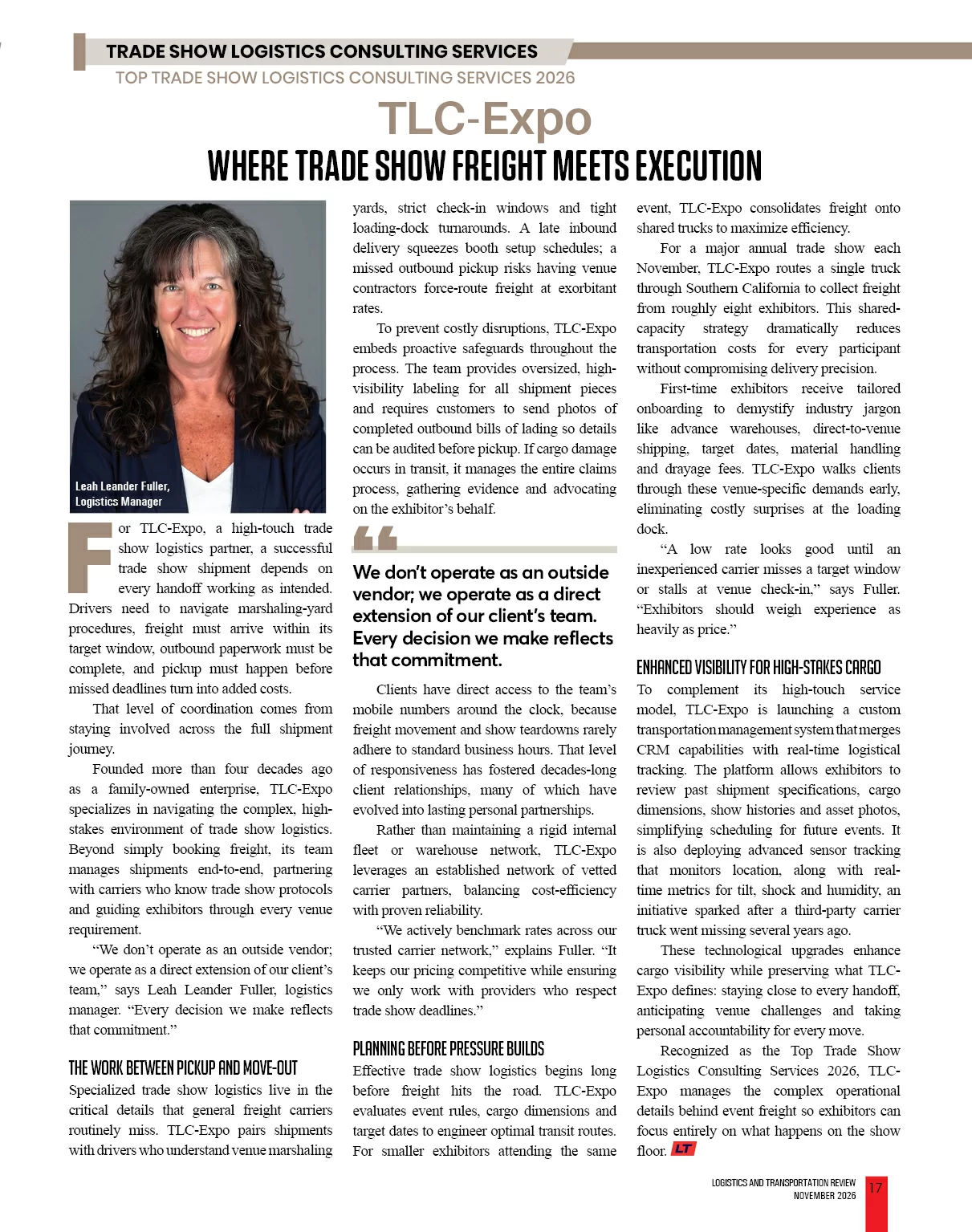
 Leah Leander Fuller, Logistics Manager
That level of coordination comes from staying involved across the full shipment journey.
Founded more than four decades ago as a family-owned enterprise, TLC-Expo specializes in navigating the complex, high-stakes environment of trade show logistics. Beyond simply booking freight, its team manages shipments end-to-end, partnering with carriers who know trade show protocols and guiding exhibitors through every venue requirement.
“We don’t operate as an outside vendor; we operate as a direct extension of our client’s team,” says Leah Leander Fuller, logistics manager. “Every decision we make reflects that commitment.”
The Work Between Pickup and Move-Out
Specialized trade show logistics live in the critical details that general freight carriers routinely miss. TLC-Expo pairs shipments with drivers who understand venue marshaling yards, strict check-in windows and tight loading-dock turnarounds. A late inbound delivery squeezes booth setup schedules; a missed outbound pickup risks having venue contractors force-route freight at exorbitant rates.
To prevent costly disruptions, TLC-Expo embeds proactive safeguards throughout the process. The team provides oversized, high-visibility labeling for all shipment pieces and requires customers to send photos of completed outbound bills of lading so details can be audited before pickup. If cargo damage occurs in transit, it manages the entire claims process, gathering evidence and advocating on the exhibitor’s behalf.
“We actively benchmark rates across our trusted carrier network,” explains Fuller. “It keeps our pricing competitive while ensuring we only work with providers who respect trade show deadlines.”
Planning Before Pressure Builds
Effective trade show logistics begins long before freight hits the road. TLC-Expo evaluates event rules, cargo dimensions and target dates to engineer optimal transit routes. For smaller exhibitors attending the same event, TLC-Expo consolidates freight onto shared trucks to maximize efficiency.
For a major annual trade show each November, TLC-Expo routes a single truck through Southern California to collect freight from roughly eight exhibitors. This shared-capacity strategy dramatically reduces transportation costs for every participant without compromising delivery precision.
First-time exhibitors receive tailored onboarding to demystify industry jargon like advance warehouses, direct-to-venue shipping, target dates, material handling and drayage fees. TLC-Expo walks clients through these venue-specific demands early, eliminating costly surprises at the loading dock.
“A low rate looks good until an inexperienced carrier misses a target window or stalls at venue check-in,” says Fuller. “Exhibitors should weigh experience as heavily as price.”
Enhanced Visibility for High-Stakes Cargo
To complement its high-touch service model, TLC-Expo is launching a custom transportation management system that merges CRM capabilities with real-time logistical tracking. The platform allows exhibitors to review past shipment specifications, cargo dimensions, show histories and asset photos, simplifying scheduling for future events. It is also deploying advanced sensor tracking that monitors location, along with real-time metrics for tilt, shock and humidity, an initiative sparked after a third-party carrier truck went missing several years ago.
These technological upgrades enhance cargo visibility while preserving what TLC-Expo defines: staying close to every handoff, anticipating venue challenges and taking personal accountability for every move.
Recognized as the Top Trade Show Logistics Consulting Services 2026, TLC-Expo manages the complex operational details behind event freight so exhibitors can focus entirely on what happens on the show floor.
What Do Trade Show Logistics Consulting Services Include?
Trade Show Logistics Consulting Services cover the planning, coordination and movement of freight associated with exhibitions, conventions and industry events. They include carrier selection, shipment scheduling, venue coordination, freight documentation, delivery monitoring and outbound collection. Unlike conventional freight arrangements, these services account for exhibition-specific requirements such as marshaling-yard procedures, advance warehouse deadlines and restricted loading-dock access. Effective coordination helps prevent delivery delays, additional handling expenses and disruptions to booth preparation.
How Does TLC-Expo Coordinate Complex Exhibition Shipments?
Trade Show Logistics Consulting Services require close attention to each stage of a shipment. Founded more than four decades ago as a family-owned enterprise, TLC-Expo coordinates freight from initial planning through final collection. It works with vetted carrier partners familiar with exhibition procedures rather than maintaining a rigid internal fleet. Its team also provides around-the-clock access to staff through mobile numbers, allowing customers to address transportation issues outside conventional business hours.
Why Is Specialized Freight Planning Important for Trade Shows?
Trade Show Logistics Consulting Services help manage the timing and procedural requirements that distinguish exhibition freight from routine transportation. Shipments must reach designated venues within specific delivery windows, while outbound collections often depend on tightly scheduled dismantling activities. Planning also involves reviewing cargo dimensions, event regulations and transit routes. These considerations help reduce missed deadlines, unexpected material handling charges and complications that can affect an exhibitor's ability to prepare or dismantle its booth.
What Operational Safeguards Improve Exhibition Freight Reliability?
Reliable Trade Show Logistics Consulting Services combine shipment visibility with accurate documentation and proactive handling procedures. Clear identification of individual freight pieces, verified bills of lading and timely communication help reduce confusion during venue deliveries and collections. Providers should also have a defined process for addressing cargo damage, including evidence collection and claims coordination. These safeguards are particularly important when multiple shipments, strict venue schedules and several transportation partners are involved in one event.
How Can Consolidated Shipping Reduce Trade Show Transportation Costs?
Trade Show Logistics Consulting Services can improve transportation efficiency by combining compatible shipments traveling to the same exhibition. Shared truck capacity allows multiple exhibitors to distribute transportation expenses without requiring separate vehicles for every shipment. TLC-Expo applies this approach by coordinating collection routes for smaller exhibitors attending the same event. Its November operation in Southern California, for example, involves a single truck collecting freight from approximately eight exhibitors, helping reduce individual shipping costs.
How Is Technology Changing Trade Show Logistics Consulting Services?
Trade Show Logistics Consulting Services increasingly incorporate digital tools that improve shipment visibility and planning accuracy. TLC-Expo is developing a transportation management system combining customer relationship management capabilities with real-time logistics tracking. The platform is designed to retain shipment specifications, cargo dimensions, event histories and asset photographs for future planning. It is also deploying sensor-based tracking to monitor shipment location and conditions such as tilt, shock and humidity, providing additional visibility into cargo movement.
| Share this Article: Tweet |
Company
TLC-Expo
Management
Leah Leander Fuller, Logistics Manager
Description
TLC-Expo specializes in trade show logistics, coordinating shipments through trusted carrier relationships. With over four decades of experience, it manages delivery schedules, show requirements, paperwork and pickups while providing hands-on support that keeps exhibitors’ freight moving from beginning to end.